When two or more workers are doing tasks that can affect the results of each other, synchronizing their actions can become critical. Say two processing cores try to do these two jobs (assume that x refers to a location in memory where the value 5 is stored):
    Worker A's Task
1   get x from memory
2   add 10
3   store total to x in memory
    Worker B's Task
1   get x from memory
2   add 1
3   store total to x in memory
Depending on the timing, we could end up with 15, 6, or 16 stored as the value for x! How? Well, we know that each worker will do their three steps in order, but we have no guarantee on the relative ordering between the two workers.
A1 runs, and program A gets 5. B1 runs, and B gets 5. B finishes steps 2 and 3, ( x now is 6). Then A finishes steps 2 and 3 but using the value of 5 it already retrieved ( x now is 15)
A1 runs, and program A gets 5. B1 runs, and B gets 5. A finishes steps 2 and 3, ( x now is 15). Then B finishes steps 2 and 3 but using the value of 5 it already retrieved ( x now is 6)
A situation like this is possible in a multi-core computer where two cores are running different threads of a program that share data. When a core accesses a piece of data, it will store it into a register and work with that stored copy. Only once it is done will it write the updated value back to the original location in memory.
It is even more likely we will have issues when many workers are trying to access the same data and they hold the copied data for longer periods of time. This is common in systems where multiple computers are sharing resources over a network. Imagine a scenario where multiple computers are all trying to work with information in a shared database — each computer will retrieve records, work with them, and then eventually update the database with new data. If multiple computers try to update the same record at the same time, conflicts can arise.
The potential for different results depending on which worker acts first is called a race condition and leads to nasty bugs in programs (you likely only see the error occasionally, making it very hard to track down).
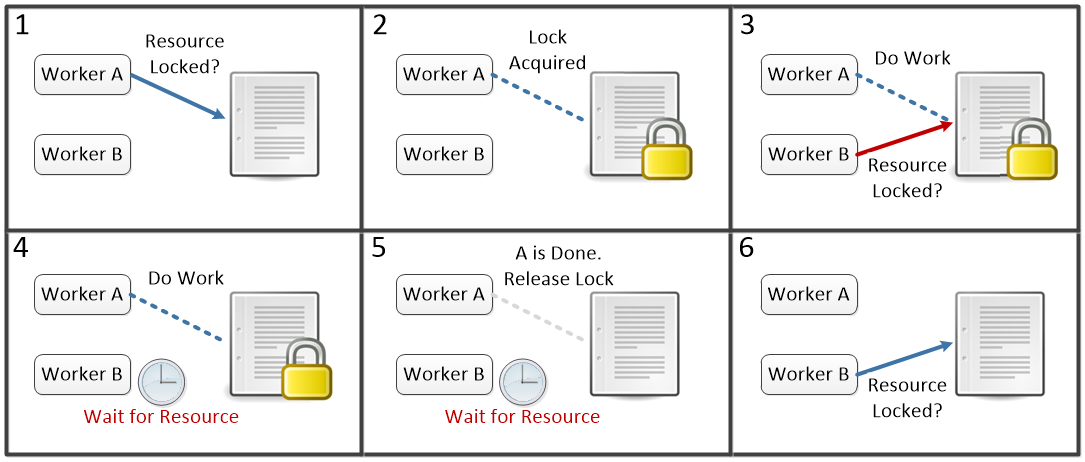
One solution to synchronization issues is to add locks to certain resources (like pieces of memory or hardware). Before using a locked resource, a worker has to check if anyone else already has locked it. If not, the worker acquires a lock- marking that resource as in use. When it is locked, anyone else who wishes to use it must wait until the lock is released.
In the example above Worker A gets to a resource first and acquires a lock (step 1). Thus when B checks in step 3, it finds out it will have to wait until the resource is free. At some point after the lock is released (step 5), B will go try again to see if the resource is free. Note that for this scheme to work, we need a command “check and acquire lock” that can be done as one atomic action - in other words, there is no actual gap between steps 1 and 2 - they can never be separated. If someone else could act between steps 1 and 2 there would be no guarantee that the resource that looked free to A in step 1 was still free in step 2.
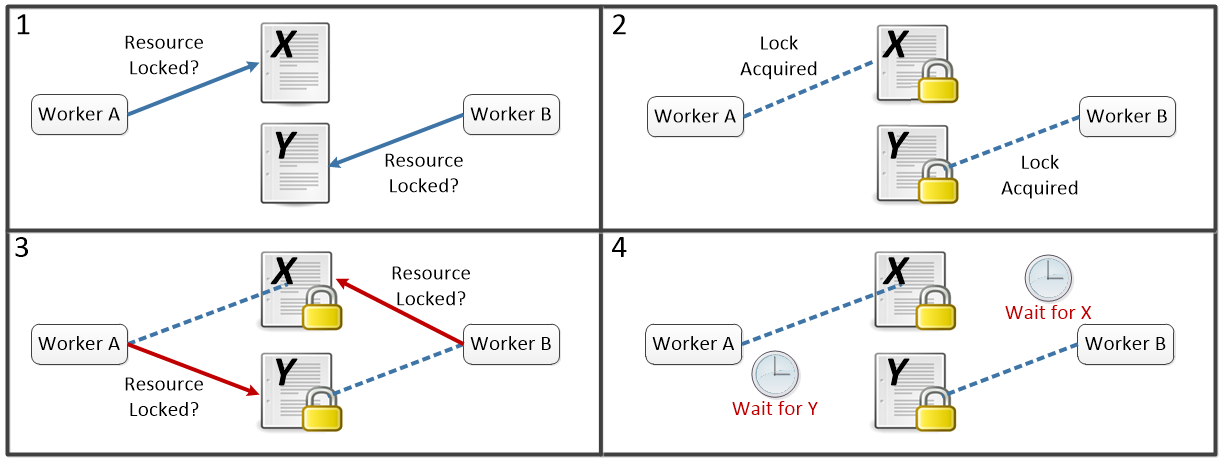
Introducing locked resources has some big drawbacks. First, by definition, any work that is happening on a locked resource is serial - only one worker can do anything with the resource at a time. The more time the code spends working within locks, the less able workers are to run in parallel. Second, we introduce the possibility of a deadlock. Say we have two workers that both need to use two locked resources, X and Y to complete their work. We could end up in a situation where each is waiting for the other to release a lock it needs:
Only one worker can access a resource at a time. Any time we allow locks, this will be met. Only by allowing both workers to access the resource at the same time can avoid this.
A worker can hold onto a lock while they wait on another resource. We might be able to avoid deadlock if in step 4 both workers had to release their existing lock and start over trying to acquire a lock on both X and Y. (To avoid going right back to step 1 every time, we might make each Worker wait a small random amount of time before trying for the locks).
No one can be forced to give up their lock. We could say that Worker A can make B give up a lock if they want. Or we could say that anyone who has the lock on X can make someone else give up a lock on Y.
None of the possible fixes mentioned to the conditions for deadlock are without issue. We can very easily end up “starving” one worker who is forced to wait all the time for their resources. It is also notoriously hard to figure out in advance exactly who needs to lock what resources for how long and how conflicts should be resolved - even experienced programmers can easily make small mistakes that go unnoticed but lead to crashes or data corruption.
Initially, x is 5. Worker A wants to add 3 to it, and Worker B wants to add 2 to it. Arrange the blocks to show an execution in which the final value of x is 8.
Worker A gets x = 5 from memory.
 #tag:a; depends:;
---
Worker A adds 3, producing 8.
 #tag:b; depends:a;
---
Worker B gets x = 5 from memory.
 #tag:c; depends:;
---
Worker B adds 2, producing 7.
 #tag:d; depends:c;
---
Worker B stores 7 to x in memory.
 #tag:e; depends:d;
---
Worker A stores 8 to x in memory.
 #tag:f; depends:b,e;