The formula gives us the solutions of a particular quadratic equation in terms of its coefficients, \(a,~b,\) and \(c\text{.}\) We know that there should be two solutions, and the symbol \(~\blert{\pm}~\) is used to represent the two expressions
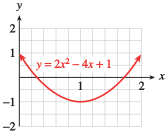
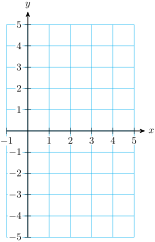
Remeber that we cannot cancel the 4’s in this expression! \(~\alert{\text{[TK]}}~~\) Using a calculator, we find that the solutions are approximately \(1.7\) and \(0.3\text{.}\) These values are the \(x\)-intercepts of the graph of \(~y = 2x^2 - 4x + 1,~\) as shown in the figure.
Factoring and extraction of roots are relatively fast and simple, but they do not work on all quadratic equations. The quadratic formula will work on any quadratic equation.
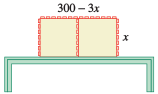
The owners of a day-care center plan to enclose a divided play area against the back wall of their building, as shown below. They have \(300\) feet of picket fence and would like the total area of the playground to be \(6000\) square feet. Can they enclose the playground with the fence they have, and if so, what should the dimensions of the playground be?
Suppose the width of the play area is \(x\) feet. Because there are three sections of fence along the width of the play area, that leaves \(300 - 3x\) feet of fence for its length.
When we evalute this last expression, we get two different positive values for the width of the play area, \(x = 72.4\) or \(x=27.6\text{.}\) Both values give solutions to the problem. To find the length of the playground in each case, we substitute \(x\) into \(300-3x.\)
If the width of the play area is \(72.4\) feet, the length is \(300 - 3(72.4)\text{,}\) or \(82.8\) feet.
Not all quadratic equations have solutions that are real numbers. For example, when we try to solve the equation \(~x^2+4=0,~\text{,}\) we find
\begin{align*}
x^2 \amp =-4\\
x \amp = \pm \sqrt{-4}
\end{align*}
Although square roots of negative numbers such as \(\sqrt{-4}\) are not real numbers, they occur frequently in mathematics and its applications. Mathematicians in the sixteenth century gave them the name imaginary numbers, which reflected the mistrust with which they were viewed at the time. Today, however, such numbers are well understood and are used routinely by scientists and engineers.
Thus, the square root of any negative real number can be written as the product of a real number and \(i\text{.}\) Every negative real number has two imaginary square roots. For example, the square roots of \(-9\) are \(3i\) and \(-3i\text{.}\) You can verify that
For this equation, \(a=\alert{2}\text{,}\)\(b=\alert{-1}\text{,}\) and \(c=\alert{2}\text{.}\) We substitute these values into the quadratic formula to obtain
\begin{equation*}
y = ax^2 + bx + c
\end{equation*}
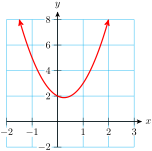
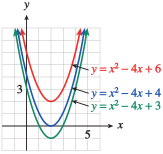
may have two, one, or no \(x\)-intercepts, according to the number of distinct real-valued solutions of the equation \(ax^2 + bx + c = 0\text{.}\) For example, consider the three graphs shown at right.
A closer look at the quadratic formula reveals useful information about the solutions of quadratic equations. The sign of the number under the radical determines how many solutions the equation has. For the three equations above, we calculate as follows:
For example, if we know that one solution of a particular quadratic equation is \(3+\sqrt{2}\text{,}\) the other solution must be \(3-\sqrt{2}\text{.}\) If one solution is \(5-3i\text{,}\) the other solution must be \(5+3i\text{.}\)
The expression \(~b^2-4ac~\text{,}\) which appears under the radical in the quadratic formula, is called the discriminant, \(D\text{,}\) of the equation. The value of the discriminant determines the nature of the solutions of the equation. In particular, if the discriminant is negative, the equation has no real-valued solutions; the solutions are complex numbers.
Expressions in \(y\) are treated as constants with respect to \(x\text{,}\) so that \(a = \alert{1}\text{,}\)\(b = \alert{-y}\text{,}\) and \(c = \alert{y - 2}\text{.}\) We substitute these expressions into the quadratic formula.
What is the sum of the two solutions of the quadratic equation \(~ax^2 + bx + c = 0~\text{?}\) (Hint: The two solutions are given by the quadratic formula.)
What is the product of the two solutions of the quadratic equation \(~ax^2 + bx + c = 0~\text{?}\) (Hint: Do not try to multiply the two solutions given by the quadratic formula! Think about the factored form of the equation.)
A car traveling at \(s\) miles per hour on a wet road surface requires approximately \(d\) feet to stop, where \(d\) is given by the equation
\begin{equation*}
d = \dfrac{s^2}{12}+\dfrac{s}{2}
\end{equation*}
Make a table showing the stopping distance, \(d\text{,}\) for speeds of 10, 10, \(\ldots\text{,}\) 100 miles per hour. (Use the Table feature of your calculator.)
Insurance investigators at the scene of an accident find skid marks 100 feet long leading up to the point of impact. Write and solve an equation to discover how fast the car was traveling when it put on the brakes. Verify your answer on your graph.
A high diver jumps from the 10-meter springboard. His height in meters above the water \(t\) seconds after leaving the board is given by
\begin{equation*}
h=-4.9t^2+8t+10
\end{equation*}
Make a table of values showing the diver’s altitude at 0.25-second intervals after he jumps from the springboard. (Use the Table feature of your calculator.)
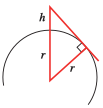
When you look down from a height, say a tall building or a mountain peak, your line of sight is tangent to the Earth at the horizon, as shown in the figure.
The radius of the earth is 6370 kilometers. How far can you see from an airplane at an altitude of 10,000 meters? (You will need to use the Pythagorean theorem.)
Suppose you are standing on top of the Petronas Tower in Kuala Lumpur, 1483 feet high. How far can you see on a clear day? (The radius of the Earth is 3960 miles. Don’t forget to convert the height of the Petronas Tower to miles.)
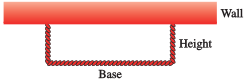
You have 72 feet of rope to enclose a rectangular display area against one wall of an exhibit hall. The area enclosed depends upon the dimensions of the rectangle you make. Because the wall makes one side of the rectangle, the length of the rope accounts for only three sides, as shown below.