Section 3.7 Sequential If Statements
Subgoals for Evaluating Selection Statements.
-
Diagram which statements go together by indentation
-
For conditional, determine whether expression is true
-
If true, follow true branch
-
If false, follow next elif/else branch or exit conditional if no else branch
-
-
Repeat step 2 as necessary
Subsection 3.7.1
Given the following declarations:
alpha = 2
beta = 1
delta = 3
eta = 0
gamma = 0
Evaluate these statements and determine the value of all variables used.
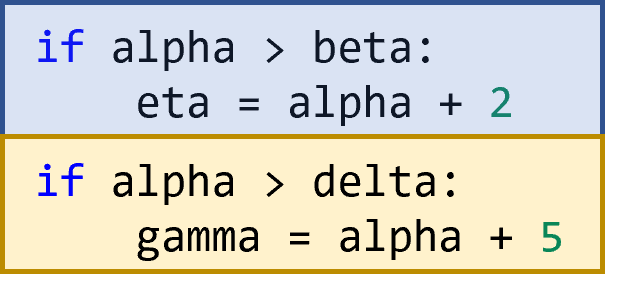
if alpha > beta:
    eta = alpha + 2
if alpha > delta:
    gamma = alpha + 5
Subsection 3.7.2 1. Diagram which statements go together by indentation
There is a single indented statement in the body of the first
if statement, and a single indented statement in the body of the second if statement.
Subsection 3.7.3 2. For conditional, determine whether expression is true
Because there are 2 sequential if-statements, we start with the first one, and then repeat SG2 and SG3 for the other.
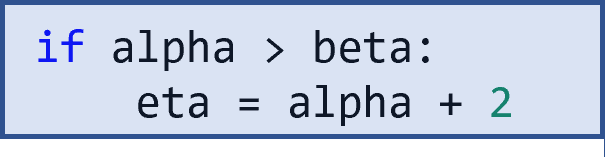
First we evaluate alpha > beta:
2 > 1 is True.
Subsection 3.7.4 3. If true, follow true branch; If false, follow next elif/else branch or exit conditional if no else branch
The condition is
True, so we execute the true branch.
eta = alpha + 2
= 2 + 2
= 4
Subsection 3.7.5 SG2: For if statement, determine whether expression is true
Because there are 2 sequential if-statements, we need to repeat SG2 and SG3 for the second if-statement in the sequence.
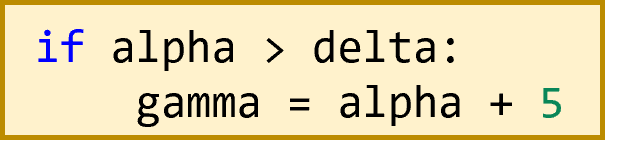
First we evaluate alpha > delta:
2 > 3 is False
Subsection 3.7.6 SG2.2: If false, follow next elif/else branch or exit conditional if no else branch
The condition is FALSE and there is no else branch, so we do nothing.
Answer.
alpha = 2, beta = 1, delta = 3, eta = 4, gamma = 0
Practice Pages.
You have attempted of activities on this page.

